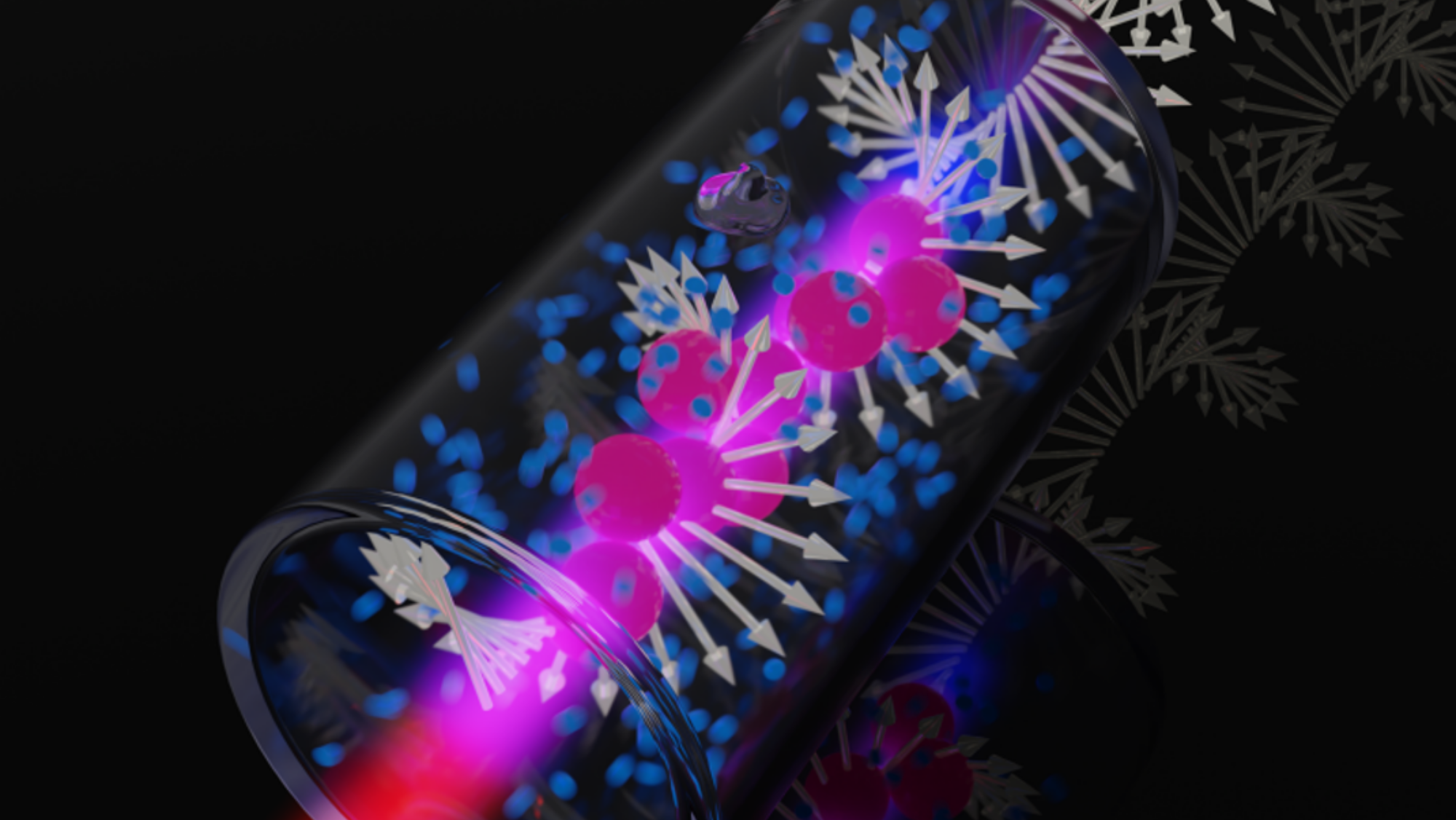
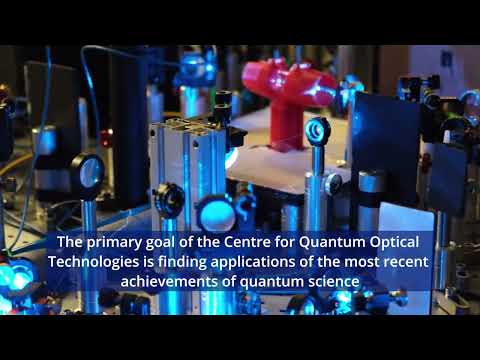
The QOD Lab at the Faculty of Physics – University of Warsaw and QOT Centre for Quantum Optical Technologies (hosted by Centre of New Technologies – University of Warsaw) led by Michał Parniak studies the fundamentals and applications of optical devices operating in the quantum regime. Our focus is on imaging systems, where we use quantum information theory to improve classical imaging systems and work to develop new imaging methods that exploit the full quantum information present in the optical field. We are also studying quantum nonlinear processes in atomic media to implement quantum image processing at the level of single photons. To this end, we seek to exploit giant Rydberg atoms that can mediate interactions between photons. Finally, we also use atomic media to explore imaging in the time and frequency domain, both in the ultranarrowband and ultrafast regimes. Applications of such atomic systems range from communication, where they can operate as transmitter or receiver, to quantum sensing
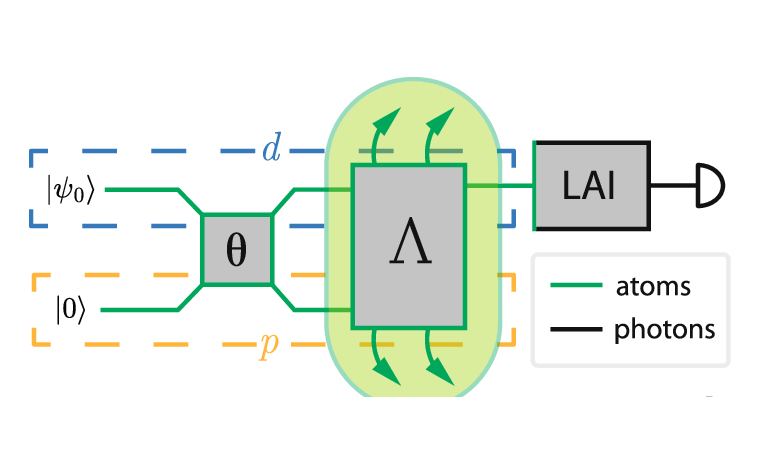
We used Rydberg atoms both to sense a microwave field and to process the information they collect. Dipolar interactions between the atoms implement an error-prevention protocol against losses at the detection stage: counterintuitively, adding a non-linear, lossy channel triples the Fisher information. A single 160-ns microwave pulse is measured with a precision of (217 ± 8) µV/cm.
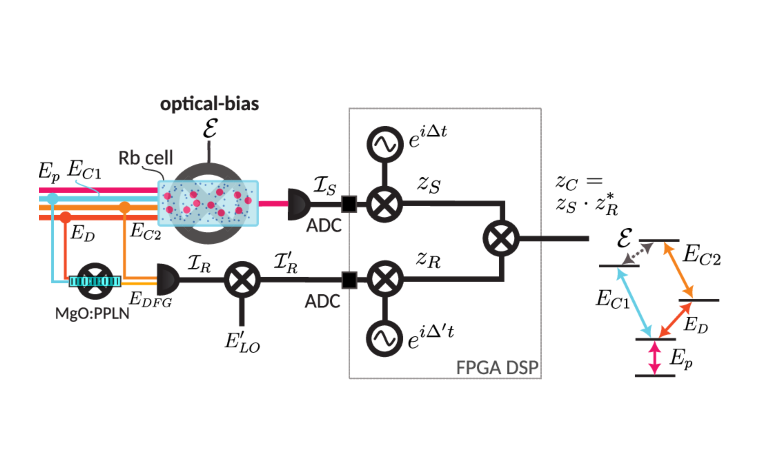
We introduced optical-bias detection: a Rydberg receiver that stays fully optical, with no microwave local oscillator, yet reaches high sensitivity. Measuring laser phase noise with a nonlinear process and correcting it in real time improves the signal-to-noise ratio by 35 dB, giving 176 nV/cm/√Hz, reliable operation up to 3.5 mV/cm and reception of QAM data.
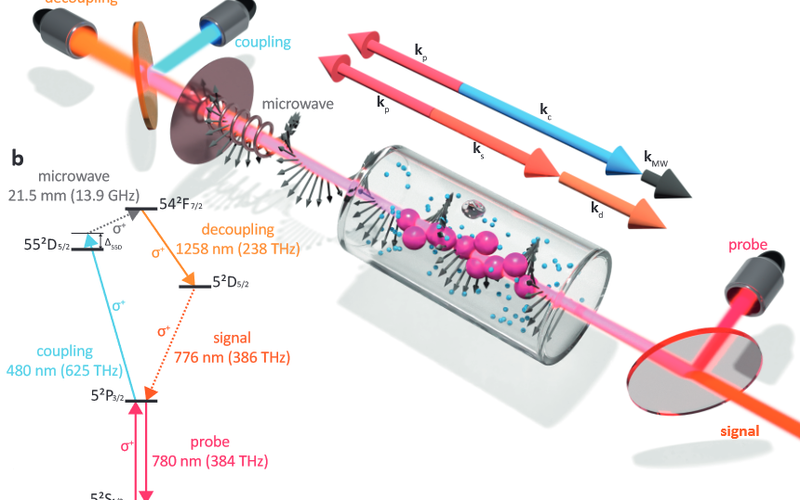
We used Rydberg atoms in a hot-vapor cell to convert microwaves into light via a six-wave mixing process. Thanks to a unique scheme, we achieve good efficiency, large bandwidth, and no detectable intrinsic noise. That allowed us to detect upconverted thermal radiation (corresponding to only roughly 1.5 nV/cm/(rad/s)1/2 with photon counting), and observe its photon-counting correlations and two-photon interference between thermal radiation and a coherent microwave. Those feats will enable to photonic-microwave interfaces to operate in convenient room-temperature conditions, with applications from fundamental science to technology.
See link for other research highlights of the group leader from PhD and postdoc.
ERC Starting Grant for Michał Parniak— Michał Parniak receives an ERC Starting Grant (€2M) for QURA – quantum sensors of microwave, millimetre-wave and terahertz fields.